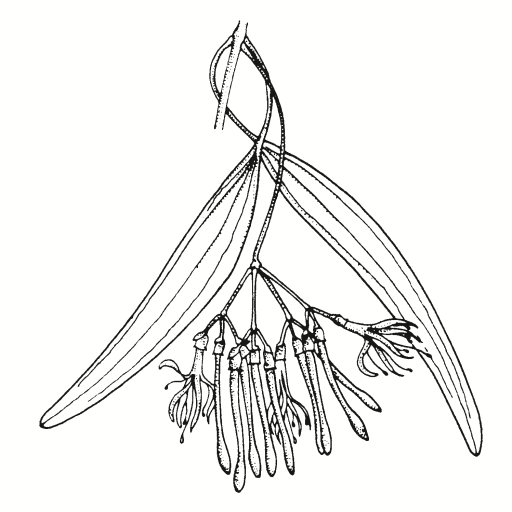
Family:
Malvaceae
Brachychiton populneus
Kurrajong
(syn. Sterculia diversifolia)
Other Names: n/a

Name Origin:
Brachychiton — from Greek brachys, short, and chiton, under- garment or outer covering, referring to loose outer covering of seeds.
populneus — from Latin populnus, poplar-like, referring to similarity of adult leaves to those of European poplar.
Regional Subspecies:
Brachychiton populneus subsp. populneus; B. p. subsp. triblobus
Habit:
Evergreen tree to 20 m high. Strongly tapering trunk, dense crown. Creamy-white flowers speckled with dark red, Mar-Dec. Slow-growing initially, then rapid, very long-lived.
Habitat & Site Preference:
Common in many communities, including Mallee. Prefers well-drained soil, drought tolerant. Sensitive to frost when young, tolerates alkaline soil. Prefers 300 – 500 mm rainfall in the Riverina.
Seed Collection & Propagation:
Collect early Jul-late Jan, seeds released 3-14 days after maturity. Handle with care due to irritating hairs. Propagate from seed (±8 viable/gram), soak in hot water before sowing. Sow in large pots or beds, transplant to temporary beds in winter, then to final site the following winter. Seedlings over 60 cm transplant readily. Regenerates from seed dispersed by birds.
Values & Uses:
Excellent shade tree, suitable for clump planting. Medium-level windbreak cover. Useful for recharge control. Attracts nectar-feeding birds and insects. Timber light, soft, used for lattice construction and interiors. First Nations used bark for string and nets, roots for water, seeds for food and flour. Edible grubs. Ornamental tree for gardens, parks, and avenues. Excellent drought fodder, responds well to lopping. Roasted seeds used as coffee substitute. Leaves produce dyes.