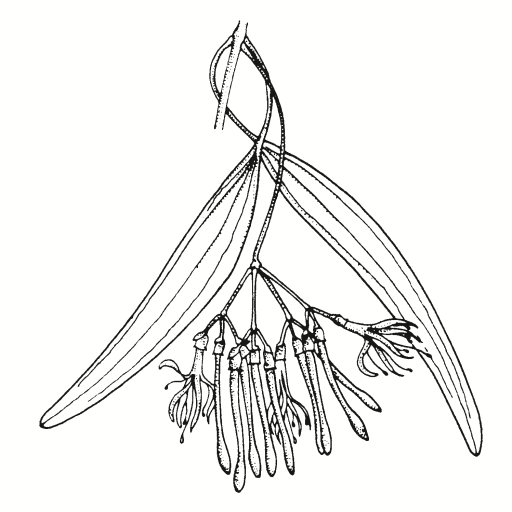
Family:
Fabaceae
Acacia salicina
Cooba
Other Names: Native Willow, Willow, Broughton, Doolan, Willow Wattle.

Name Origin:
salicina – from Latin salicis, referring to pendulous, willow-like habit.
Regional Subspecies:
n/a
Habit:
Erect or spreading shrub or tree, 3-10 m high. Brownish, finely fissured bark, deep-green foliage on willow-like drooping branches. Often forms dense clumps. Pale yellow to almost white flowers, Feb-Jun. Longlived and wind-firm.
Habitat and Site Preference:
Dry sclerophyll forest, shrubland, and woodland in semi-arid regions. Found on creek banks, alluvial plains, and floodplains. Prefers heavy clay to sandy soils, tolerates inundation, full sun, salt, and drought. Resents frost when young. Prefers 300 – 500 mm rainfall in the Riverina.
Seed Collection and Propagation:
Collect Dec-Jan, good crops every few years. Propagate from seed (±8 viable/gram). Regenerates easily from seed and root suckers. Fencing recommended to protect from livestock.
Values and Uses:
Excellent low to medium-level cover in windbreaks due to bushiness and suckering. Valuable for riverbank stability and erosion control. Improves soil fertility (legume). Provides food for native birds and insects. Good fuelwood. Timber used for furniture, crafts, and historically for bullock yokes and cart shafts. First Nations used bark for fish poison and seeds for food. Attractive ornamental for dry areas, responds well to watering. Excellent drought fodder.