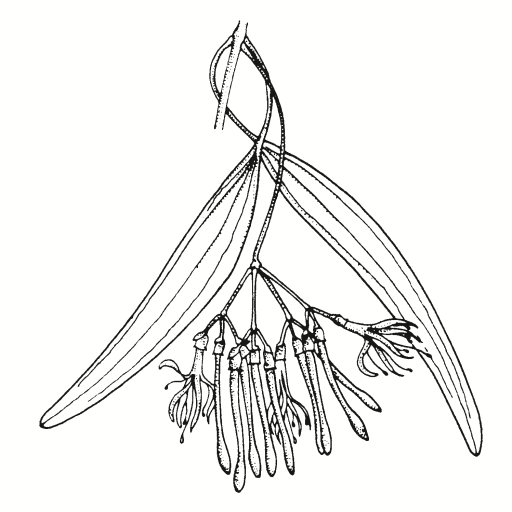
Family:
Myoporaceae
Myoporum montanum
Western Boobialla
Other Names: Water Bush, Boobialla, Boomeralla, Native Daphne, Native Myrtle.

Name Origin:
Myoporum — from Greek myo, to be closed and poros, pore, referring to closed appearance of leaf glands.
montanum — from Latin montanum, of the mountains.
Regional Subspecies:
n/a
Habit:
Hairless, erect, bushy shrub or small tree up to 8 m high. It features finely fissured bark and narrow leaves about 3-14 cm long. Produces white, purple-spotted flowers, and usually grows as scattered plants or in small, relatively dense colonies. White flowers spotted with purple from August to December.
Habitat & Site Preference:
Found in Mallee, Grey Box, Belah-Rosewood, and Black Box communities. Prefers well-drained soil in full sun and a rainfall of 300 to 500 mm in the Riverina region.
Seed Collection & Propagation:
Collect seeds early Feb-late Mar, monitoring closely as they shed 3-14 days after maturity. Propagate from cuttings of firm young growth or seed. For seed propagation, remove fruit flesh and soak overnight in warm water before sowing in late summer to early autumn. Cover with 2-3 mm of seed-raising media and 4 mm of fine gravel. Place seed trays in an open shaded position. Tolerates severe drought and exhibits low flammability. Appears to be unpalatable to livestock.
Values & Uses:
Excellent low-level cover in windbreaks. Excellent habitat, flowers provide pollen and nectar, fruits eaten by birds. First Nations used gum as glue and leaves medicinally. Attractive ornamental for windbreaks, parks, screens, or hedges. Prune lightly and regularly to promote bushiness.