Family:
Poaceae
Rytidosperma spp.
Wallaby Grasses
Other Names: n/a
Regional Subspecies:
refer to text
HABIT:
Tufted perennial grasses with fine leaves and fluffy seedheads. Grows year-round.
HABITAT & SITE PREFERENCE:
Variable soil and vegetation types. Prefers 300 to 500 mm rainfall in the Riverina region.
SEED COLLECTION & PROPAGATION:
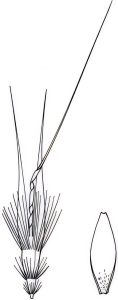
Collect seed when seedheads turn off-white, dry out, and start to disintegrate. Propagate from surface-sown seed, division of clumps, or transplants. Fast growth rate. Tolerates severe frost and drought. Recommended species: R. bipartita, R. caespitosum (Common Wallaby Grass), R. duttonianum (Brown-black Wallaby Grass), R. erianthum (Hill Wallaby Grass) [pictured], R. fulvum, R. laeve, R. linkii var. fulvum (Wallaby Grass), and R. setaceum (Bristly Wallaby Grass). Available from specialist nurseries.
VALUES & USES:
Excellent grazing value and a vital part of natural pastures; valued for persistence, palatability, and productivity. Beneficial on recharge areas. Tends to produce high-quality forage in winter and withstands seasonal grazing. Provides excellent habitat, serving as food for seed-eating birds and cover for reptiles, including legless lizards. Also a food source for native grazers and butterfly larvae. Offers excellent contrast in native landscaping and rockeries. Rejuvenate old plants by severe trimming or burning, followed by watering to encourage growth.